01
What this one is
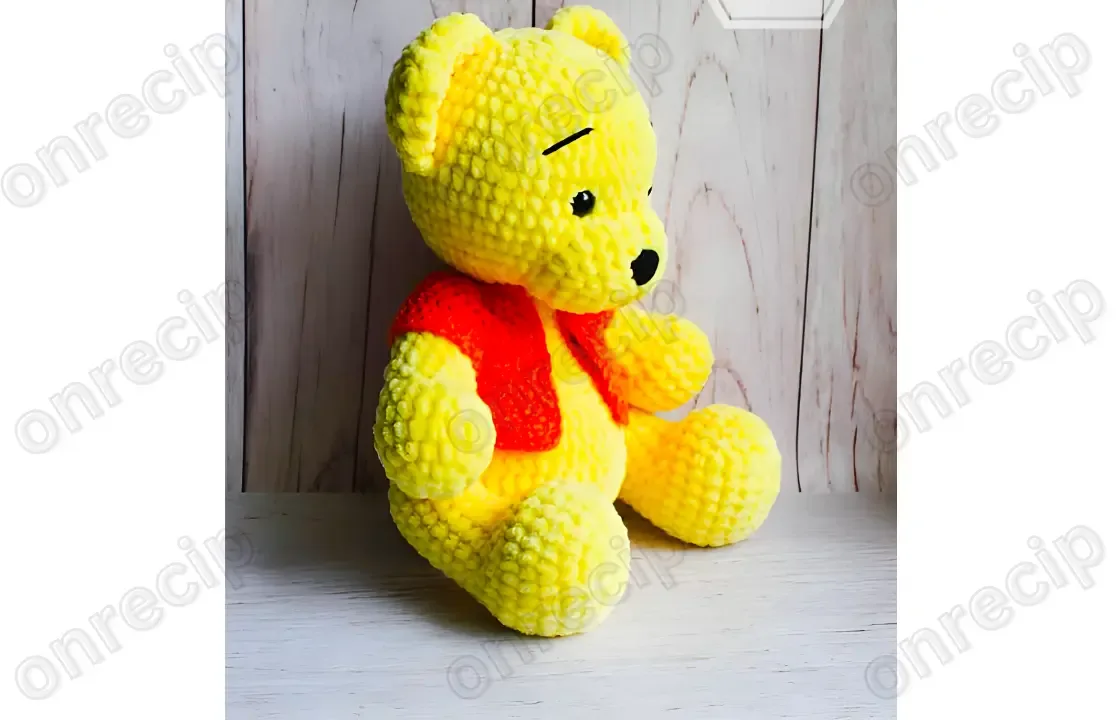
This bear is the kind of thing you make on an evening when you'd rather have soft plush yarn moving through your fingers than the television on. It suits someone who already knows their way around a magic ring and a basic increase, and who wants a toy that feels finished, not just cute. Make it for a child who needs something to hold, or for yourself, because a good bear is never really outgrown.
Your hands spend most of the time doing three things: working single crochet in a continuous spiral, increasing steadily so a flat circle grows into a rounded limb or head, and stuffing firmly as each piece closes. None of it is difficult, but there's enough shaping and enough pieces that you should plan for a few sittings rather than one. All told, this comes together in roughly four to six hours from first stitch to sewn-on nose.
02
Try it another way
The easiest change is scale: work the same increase sequence - 6, then 12, then 18 stitches - with a finer yarn and a smaller hook and you'll land well under the 28 cm finished height, closer to a pocket-sized keeper. Go the other way with a chunkier plush yarn and a 4 mm hook throughout, rather than the 3.5 mm, and the bear grows softer and rounder without changing a single round count. Color placement is an easy way to make each bear feel different: keep the body and head in one shade and work just the arms, or just the tips of the ears, in a contrast color for a paw-pad look. If this bear is meant for a very young child rather than a shelf, skip the 12 mm eyes and 20 mm beak altogether and embroider the face instead with yarn, which removes any small hard parts. And if you'd rather make a smaller companion piece, the same 6-12-18 increase pattern used for the limbs works nicely on its own as a tiny stuffed ball ornament or a keychain base, just stop before the shaping calls for more length.
What makes this bear satisfying is watching a flat six-stitch magic ring turn into something with real volume in just a couple of rounds - six to twelve to eighteen stitches, and suddenly you're holding a leg instead of a disc. The continuous spiral keeps your hands moving without the interruption of turning or joining, so you settle into a rhythm fast. Working with plush yarn instead of a standard worsted also changes the feel of every stitch: it's forgiving, it hides small tension slips, and it gives the finished bear that soft, huggable surface that a smoother yarn never quite manages. Setting the 12 mm eyes and 20 mm nose at the end is the moment the whole thing stops being a pile of stuffed shapes and becomes a face.