Intermediate 15-22 hours DK (Light) yarn

Worked on the glider, counted out loud —

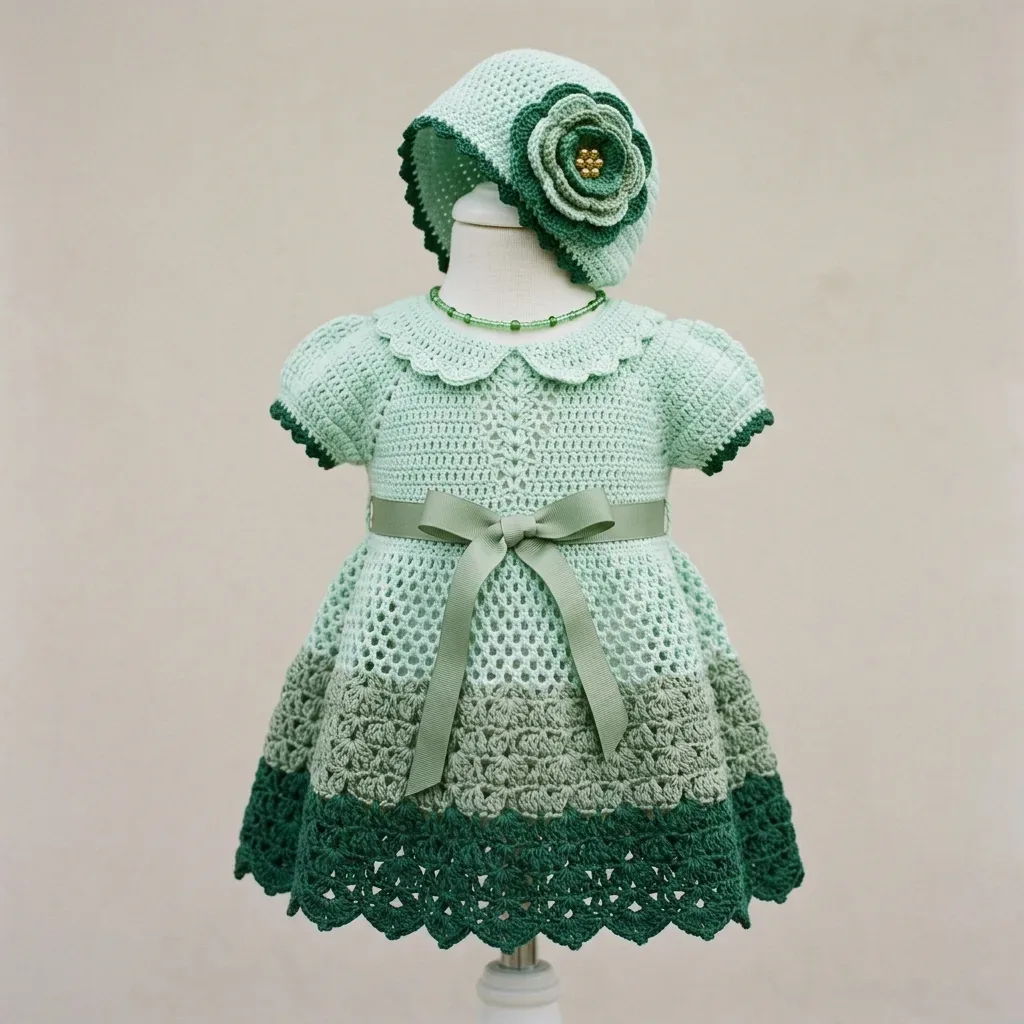
Soft raglan baby dress in mint and sage green

A soft raglan baby dress in mint and sage, sized 3-6 months, made in DK yarn over about 15-22 hours.

Jump to the rounds

What this one is

This is the dress you reach for on a quiet evening, working by lamp light while the rest of the house settles down, making something small and soft for a baby around three to six months old. The mint, sage, and deep forest green feel gathered from the same garden bed, gentle enough for everyday wear and sweet enough for a special gathering photo. It's a piece made with real intention, not just worked through.

Your hands spend most of the time working double crochet in rows across the yoke, placing and shifting stitch markers at each raglan point so the increases land exactly where they should. From there you move into the skirt, the bonnet, and a lace collar edged in the smaller hook. Altogether, counting every piece, you're looking at roughly fifteen to twenty-two hours, with the hem border asking for the most patience.

The rounds, in full

Written out, round by round

Intermediate15-22 hours3.5 mmDK (Light)

Bring to the porch

Everything this one takes, in the order you will reach for it.

DK weight yarn (also called CYCA 3 or Light) in three coordinating shades:

  • Color A (Mint): approximately 280 yards (256 m)
  • Color B (Sage): approximately 120 yards (110 m)
  • Color C (Deep Forest Green): approximately 130 yards (119 m)

Yarn suggestions that work beautifully

  • Lion Brand Pound of Love (100% premium acrylic, 1020 yards per 16 oz skein): Excellent stitch definition for lace details, machine washable, widely available in pastel greens.
  • Paintbox Yarns Simply DK (100% premium acrylic, 137 yards per 50g ball): Great color consistency across dye lots, very affordable, holds its shape well after washing.
  • Drops Safran (70% cotton, 30% polyester, 175 yards per 50g ball): A cotton-blend option for warmer climates or sensitive skin. The slightly heavier drape will enhance the lace skirt panels.

Important

  • Avoid fuzzy or highly textured yarns. The beautiful stitch detail in the lace panels and shell borders will get lost. Stick with smooth yarn for the best results.
  • US size E-4 (3.5 mm) for the dress body and bonnet
  • US size D-3 (3.25 mm) for the collar and edgings
  • Yarn needle
  • 3 small buttons, approximately 3/8 inch (10 mm), in white or green
  • 1 yard (91 cm) satin ribbon, 5/8 inch (16 mm) wide, in sage or mint green
  • At least 4 stitch markers
  • Safety pins for holding stitches
  • Small amount of polyester fiberfill or cotton batting (optional, for the bonnet rose)

Dress - Yoke and Bodice

Foundation: With Color A and E-4 (3.5 mm) hook, ch 75.

  1. Row 1(WS): Sc in second ch from hook and in each ch across, turn. (74 sc)
  2. Row 2RS, Raglan Setup Row Ch 3 (counts as dc throughout), dc in next 6 sts, pm in next st (raglan point 1), 2 dc in next st, dc in next st, 2 dc in next st, pm in next st (raglan point 2), dc in next 16 sts, pm in next st (raglan point 3), 2 dc in next st, dc in next st, 2 dc in next st, pm in next st (raglan point 4), dc in next 6 sts, dc in last st, turn. (78 dc)After Row 2, your section breakdown looks like this: Left back: 7 sts; Left sleeve: 5 sts; Front: 18 sts; Right sleeve: 5 sts; Right back: 7 sts.
  3. Row 3Ch 3, dc in each st to first marker, 2 dc in marked st, dc in next st, 2 dc in next st, dc to next marker, 2 dc in marked st, dc in next st, 2 dc in next st, dc to next marker, 2 dc in marked st, dc in next st, 2 dc in next st, dc to next marker, 2 dc in marked st, dc in next st, 2 dc in next st, dc to end, turn. (86 dc)
  4. Row 4Rep Row 3. (94 dc)
  5. Row 5Rep Row 3. (102 dc)
  6. Row 6Rep Row 3. (110 dc)
  7. Row 7Rep Row 3. (118 dc)After Row 7, your stitch distribution should be: Each back panel: 12 sts; Each sleeve: 15 sts; Front: 28 sts; 4 raglan bridge stitches: 12 sts; Total: 118 sts. Confirm this count before moving on.

Putting it together

Step 1

1. Weave in all ends on the wrong side using your yarn needle.

Step 2

2. Sew the collar to the neckline with whip stitch using Color A, placing the collar so it is centered at the front neckline and laying flat.

Step 3

3. Thread the satin ribbon through the ch-1 spaces of Round 12 (the ribbon channel). Begin and end at the center front. Tie into a bow.

Step 4

4. Sew 3 buttons to the right back band at positions corresponding to the button loops on the left back band.

Step 5

5. Sew the bonnet rose securely to the left side of the brim using the Color C yarn end.

Step 6

6. Block the dress by dampening with clean water, gently shaping on a flat padded surface, and pinning the hem to open up the lace details.

Marlene's notes

Note 01

Keep your four raglan markers moving up with each new row rather than removing them early; losing track of a marker is the easiest way to end up with a lopsided sleeve.

Note 02

Confirm your stitch count at the checkpoints given — 78 after Row 2, 118 by Row 7 — before you keep going, since a small miscount in the increases compounds fast over nine rounds.

Note 03

Skill Level: intermediate. You should feel comfortable working in the round, reading stitch repeats, joining new colors, and keeping track of stitch counts as you go.

Note 04

Time Estimate: approximately 15 to 22 hours for the complete set, including the dress, bonnet, and collar. The lace border at the hem is the most time-intensive section.

Note 05

Finished Measurements: fits a baby approximately 3 to 6 months old. Chest circumference: approximately 16 inches (41 cm), measured at the underarm. Dress length (shoulder to hem): approximately 14 inches (35.5 cm). Bonnet circumference: approximately 14 to 15 inches (35.5 to 38 cm).

Note 06

Important: Avoid fuzzy or highly textured yarns. The beautiful stitch detail in the lace panels and shell borders will get lost. Stick with smooth yarn for the best results.

Note 07

Gauge: With E-4 (3.5 mm) hook and Color A: 20 stitches and 22 rows = 4 inches (10 cm) in single crochet. One mesh repeat (chain 1, skip 1, double crochet) over 10 stitches = approximately 2 inches (5 cm).

Note 08

Gauge matters for this garment. A difference of even one stitch per inch will affect the chest circumference by over an inch. Work a swatch at least 5 x 5 inches, block it flat, and measure before starting the dress.

Note 09

Special Stitch - Shell Stitch: Work 5 double crochets into the same stitch or space. Each shell counts as one stitch unit when reading repeat instructions.

Note 10

Special Stitch - V-Stitch (V-st): Work (dc, ch 1, dc) into the same stitch or space. Used in the mesh panel of the skirt.

Note 11

Special Stitch - Picot: Ch 3, sl st into the first of those 3 chains.

Note 12

Special Stitch - 3-Double-Crochet Cluster (3dc-cl): Yarn over, insert hook into the indicated stitch, yarn over and pull up a loop, yarn over and draw through 2 loops (2 loops on hook); repeat this step two more times in the same stitch (4 loops on hook); yarn over and draw through all 4 loops. The cluster counts as one stitch.

Note 13

Special Stitch - Rose Cluster Stitch: Yarn over twice, insert hook into the indicated stitch; yarn over and pull up a loop (4 loops on hook); yarn over and draw through 2 loops (3 loops on hook); yarn over and draw through 2 loops (2 loops on hook); do NOT complete the treble, leave 2 loops on hook; yarn over twice, insert hook into the same stitch and repeat the pull-up and draw-through steps; yarn over and draw through all 3 loops on hook. Work 5 of these clusters in a ring of chains for the full rose motif.

Note 14

Special Stitch - Scallop Edge: Skip 2 stitches, work 5 dc in the next stitch (shell), skip 2 stitches, slip stitch in the next stitch. Each scallop uses 6 stitches.

Note 15

Pattern Note: The dress is worked top-down in joined rounds with turning where indicated.

Note 16

Pattern Note: The yoke is worked flat in rows first to create the center-back button opening, then joined for the skirt section.

Note 17

Pattern Note: Place stitch markers at the four raglan points (two underarm positions and two shoulder positions). Move them up each round.

Note 18

Pattern Note: Color A (Mint) is the primary color for the yoke, bodice, mesh panel of the skirt, and bonnet body.

Note 19

Pattern Note: Color B (Sage) is used for the rose-cluster band in the skirt and accent edging on the collar and bonnet.

Note 20

Pattern Note: Color C (Deep Forest Green) is used for the shell-stitch row at the tops of the sleeves and skirt, the deep lace border at the hem, and the edging on the collar and bonnet brim.

Note 21

Pattern Note: When instructions say "join" at the end of rounds, this means slip stitch into the top of the beginning chain or first stitch of the round.

Note 22

Pattern Note: All rounds and rows begin after the turning chain unless otherwise noted.
Before you sit down

  • Wind off your three colors ahead of time — about 280 yards of Mint, 120 of Sage, and 130 of Deep Forest Green — so you're not hunting for a fourth skein mid-round.
  • Set out at least four stitch markers before you start Row 2; you'll place them at each raglan point and lean on them through every increase row that follows.
  • Make a small dc swatch with the E-4 (3.5 mm) hook first, since the whole yoke depends on an even gauge to hit the 16 inch chest measurement.
  • Skim ahead to the Row 7 stitch count (118 stitches total) so you know what you're aiming for before the increases start piling up.

How the hours go

Foundation chain and raglan setup (Rows 1-2)
about 45 minutes to an hour, because you're placing four markers and want that first dc row dead even before shaping starts
Raglan increase rows (Rows 3-9)
about 2 to 3 hours, because each row adds increases at four separate points and the counts need checking as you go
Full set — dress, bonnet, and collar
about 15 to 22 hours total, because the lace border at the hem is the slowest, fussiest stretch of the whole project

Looking after it

  • If you've worked with one of the acrylic yarns, a gentle machine wash in cold water and a flat lay to dry will keep the stitches looking crisp without any felting risk; skip the dryer so the dc rows don't lose their shape.
  • the cotton-polyester option, hand wash in cool water, reshape the lace border while damp, and let the dress dry flat away from direct heat; store the finished set folded with the bonnet's fiberfill rose facing up so it doesn't flatten.
FAQs

Asked on the glider

the ones that come up on the glider

What size does this dress fit?

It's sized for a baby of about 3 to 6 months, with a finished chest circumference of roughly 16 inches measured at the underarm.

Can I use a different yarn weight?

Yes, but since the pattern is written for DK (CYCA 3) weight, swapping to something heavier or lighter will change your gauge and the finished size, so swatch before you commit to the full set.

How do I keep track of the raglan points?

Place a stitch marker at each of the four raglan points in Row 2 and move them up as you increase in every row that follows; losing one is the fastest way to end up with mismatched sleeves.

Why does the pattern ask me to check my count at Row 7?

Because the increases compound across nine rounds, and confirming you've reached 118 stitches by Row 7 catches a small miscount before it turns into a real problem.

Do I need both hook sizes?

Yes — the E-4 (3.5 mm) hook handles the dress body and bonnet, while the D-3 (3.25 mm) gives the collar and edgings the tighter, neater finish they need.

Is the bonnet rose necessary?

No, the small amount of fiberfill or cotton batting for the rose is optional, so you can leave it plain or swap in a simple button if you'd rather skip the stuffing step.