01
What this one is
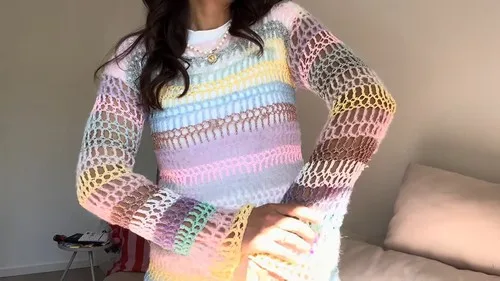
You know that drawer where the odd skeins live -- the leftover alpaca blend, a cone of glitter yarn, half a hank of silk mohair that never found its project. This sweater is for those. It's for you if you like the idea of a top that remembers every yarn that went into it, worn open over a slip or buttoned up on its own for a walk somewhere you want to be seen.
02
Try it another way
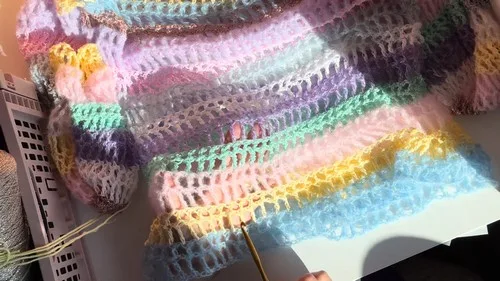
The yarn list is really an invitation: swap in whatever leftover alpaca blend, cotton, glitter, or silk mohair you've got, and let the patchwork effect be as bold or as subtle as you like by changing color every single row or only every few. For a tighter, more fitted sweater, chain fewer than the 60 foundation chains used for the small size; for something oversized, add more before you start the Main Panel. If you want drama at the cuffs, work the optional flared mermaid sleeve increase in the final two rounds of each sleeve rather than keeping the straight 10-row tight sleeve. You could also reserve your most special yarn, like the silk mohair, for just the shoulder shaping rows so it reads as an accent rather than getting lost across the whole panel. The neck edge is yours to finish or leave raw and mesh-like, since the pattern treats edging as optional. And since every panel and sleeve is built from the same two-round mesh repeat, you can genuinely use any combination of fibers in your stash as long as you keep an eye on how they feel together in a quick swatch first.
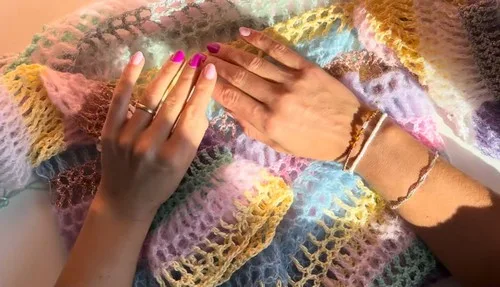
There's something quietly satisfying about a stitch pattern this simple carrying this much personality. The treble mesh and double crochet mesh alternate row by row, so every color change you make lands in a new texture band instead of a flat stripe -- that's where the patchwork feeling comes from. The shoulder shaping is the other small thrill: working those extra rows on just one side of the center, then mirroring it, gives the piece real structure instead of a floppy rectangle. And because the mesh is open and forgiving, your tension doesn't have to be perfect for it to drape well. By the time you're sewing the side seams and picking up for the sleeves, you can see a whole wardrobe of forgotten yarns turned into one wearable thing.