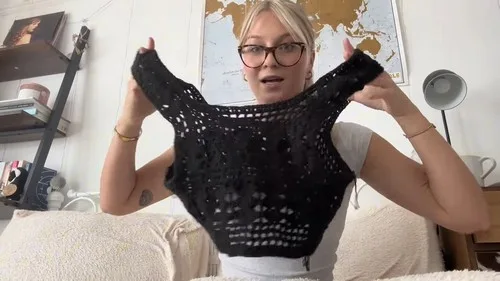
Intermediate 4-6 hours Worsted yarn

Worked on the glider, counted out loud —

Crochet shell vest top with mesh panels for summer

An easy mesh-and-shell vest top for warm evenings. About 4-6 hours for confident beginners with cotton and a 5 mm hook.

Jump to the rounds

What this one is

This one's for a warm evening when you want something on your shoulders that still lets the air through. Pull it over a slip and you're dressed for the porch; layer it over a tank and you're dressed for a walk. It's for anyone who wants a quick-to-make top that doesn't take itself too seriously but still looks like you put thought into it.

Your hands will spend most of their time alternating between two simple textures: a loose double crochet mesh and a fan of seven treble crochets blooming out of a single stitch. You chain a long foundation row, work the mesh a couple of times, then let the shells open up before circling back to mesh again. Front and back panels go up this way, then a simple strap joins them at the shoulder. Give yourself a relaxed afternoon, and you'll have a wearable top by evening.
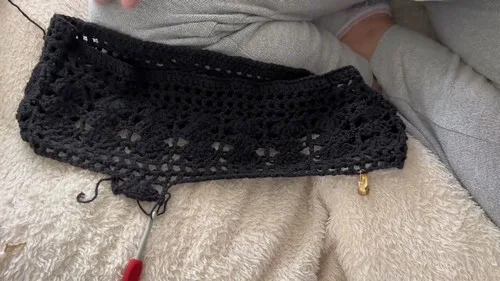
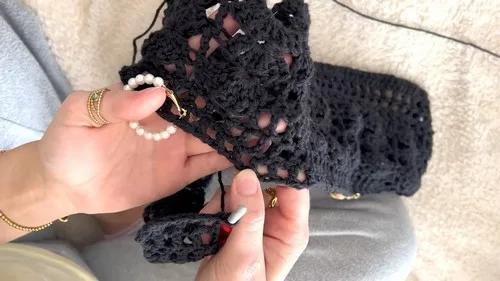
Try it another way

There's something satisfying about a shell stitch that actually behaves -- seven treble crochets blooming out of one stitch, nested right into the center of the shell below it so the whole fabric starts to ripple in a clean, repeating arc. You get to watch that pattern build row by row, alternating with the airy double crochet mesh, so the fabric keeps changing texture under your hook instead of going flat and samey. The long foundation chain of 146 (or any multiple of 8 plus 2) means you're committing to a shape early, but it also means no fiddly increases later. And because you leave the side seam open until you've checked the fit, you get to try the vest on your own body before you ever pick up a needle to close it -- which takes a lot of the guesswork out of a garment like this.

The rounds, in full

Written out, round by round

Intermediate4-6 hours5 mmWorsted

Bring to the porch

Everything this one takes, in the order you will reach for it.

  • Cotton yarn (preferably King Cole big value recycled dishcloth cotton, 3 balls)
  • 5 mm crochet hook
  • Scissors

Main Pattern

  1. Round 1Chain 4 (counts as the first double crochet + chain one), skip the next stitch, double crochet in the next stitch. Chain one, skip one stitch, double crochet in next. Repeat the sequence until the end of the row.
  2. Rounds 2–3Repeat Row 1. Step 4: Shell Stitch:

Part 2

  1. Round 1Chain 3, skip three stitches, work seven treble crochets (triple crochets) into next stitch, skip three stitches, double crochet in next stitch. Repeat from to across.
  2. Rounds 2–3Repeat Shell Stitch with each shell placed in the center stitch of the previous row’s shell.

Back to Mesh Stitch

  1. Rounds 1–3Repeat the steps for Mesh Stitch from Step 3. Joining and Side Seam Do not join the chain into a circle initially to allow for size adjustments.

Once final size is confirmed, use slip stitches to join the starting chain to the last row on the side, forming a cylinder shape. Place the seam strategically under an arm to hide it.

Putting it together

Step 1

Additional Notes:: Customize the length or the fit by increasing or reducing the number of initial chains, but maintain a multiple of 8 + 2 as required by the shell pattern.

Step 2

Adjust strap lengths based on the fitting on the body.

Marlene's notes

Note 01

The 5 mm hook paired with a firm cotton like this will feel tighter than the same hook in acrylic, so check your double crochet rows aren't curling before you move into the shell pattern.

Note 02

Each new shell needs to sit in the center stitch of the shell beneath it, so it helps to mark that center stitch with a scrap of contrasting yarn as you finish each shell row.

Note 03

Don't join the starting chain into a cylinder until you've confirmed the fit on your body -- the pattern specifically holds off on that seam so you can adjust size first.

Porch photos

Before you sit down

  • Count your starting chain carefully -- it needs to land on a multiple of 8 plus 2, and 146 is just the example number for a particular size, so adjust up or down in steps of 8.
  • Lay out your three balls of cotton and check you're comfortable with how it feels in a 5 mm hook before committing to the full width; cotton has less give than wool, so tension matters here.
  • Read through the shell stitch row once before you start it, specifically the part about seven treble crochets into one stitch, so you're not counting mid-row for the first time.
  • Decide now whether you'll try the vest on before joining the side seam -- the pattern is built to let you adjust fit at that stage, so plan for a fitting break rather than rushing straight through to the seam.

How the hours go

Main Pattern (mesh rows)
about 45-60 minutes because it's just two repeated rows of double crochet and chain-one spaces, so it moves quickly once you find the rhythm
Part 2 (shell stitch rows)
about 1-1.5 hours because placing seven treble crochets into a single stitch and centering each shell over the last takes a bit more care and counting
Back to Mesh Stitch and seaming
about 1-2 hours because you're repeating the mesh pattern across the remaining rows, then fitting and slip-stitching the side seam under the arm

Looking after it

  • Hand wash the finished vest in cool water, since cotton holds its shape better without the agitation of a machine cycle, and lay it flat to dry so the shell rows don't stretch under their own weight.
  • Store it folded rather than hung, as cotton has little stretch to recover from a hanger's pull, and give the shells a gentle reshape with your fingers after washing so the treble crochet fans sit evenly again.
FAQs

Asked on the glider

the ones that come up on the glider

Can I make this vest longer than the sample?

Yes, just add more rows alternating the mesh and shell pattern before you move to the strap and seam. Keep the mesh and shell rows in pairs so the shell stitch keeps nesting properly into the row below it.

What happens if my chain count isn't a multiple of 8 plus 2?

The shell stitch repeat depends on that exact spacing, so an off-count chain will throw the skip-three pattern out of alignment by the time you reach the treble crochet shells. It's worth recounting the chain before you turn the first row rather than discovering the mismatch several rows in.

Do I need to join the foundation chain into a circle right away?

No, the pattern specifically has you leave it open at first so you can try the vest on and check the fit. You only join it into a cylinder with slip stitches once you're happy with the size, placing the seam under the arm.

Why seven treble crochets into one stitch for the shell?

That's what gives the shell its fan shape, with all seven stitches sharing a single base stitch and spreading out from there. Skipping three stitches on either side of that base is what lets the fan have room to open up.

How do I know where to place the shell in the next row?

Each new shell sits in the center stitch of the shell directly below it, so you're essentially stacking fans on top of fans. Marking that center stitch as you finish a row makes it much easier to find on the next pass.

Is King Cole big value recycled dishcloth cotton the only yarn that will work?

It's the cotton named in the materials list and it suits the firm, breathable drape this vest wants, but any similar worsted-weight cotton with a 5 mm hook should behave the same way. Just swatch a small section first to see how your particular cotton opens up in the shell stitch.