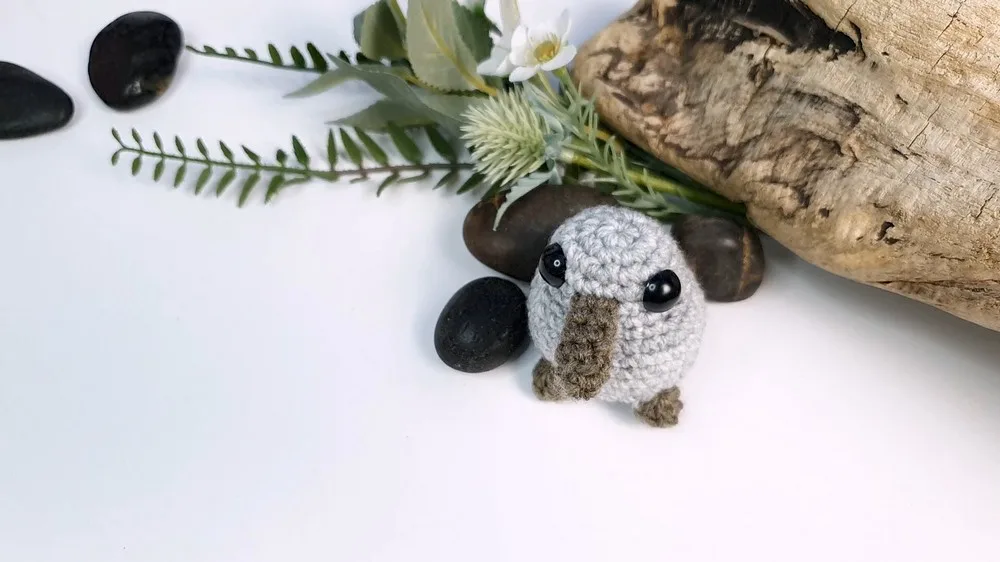
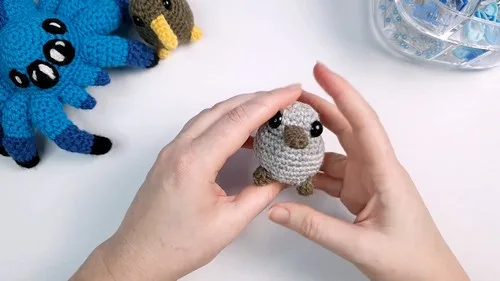
You know those quiet stretches where you want your hands busy but your mind free to wander? This little kiwi bird is made for exactly that. It's a good pick if you've made an amigurumi or two already and want something with a bit more character than a plain round body, but nothing so fussy you need a chart in front of you the whole time.
02
Try it another way
The two-color setup here is an easy place to experiment. Try swapping which color goes where — a darker main body with a bright beak color reads very differently from the reverse, and since the beak is worked entirely separately in Rounds 2 through 5 of its own four-round sequence, you can test colors without touching the body at all. If you want a bigger bird, working the same stitch counts in a bulkier yarn with a larger hook will scale things up without changing a single round. For a smaller, pocket-sized version, drop to a finer yarn and a smaller hook and expect the eighteen- and thirty-stitch rounds to come out noticeably tighter. The popcorn stitch detail in Round 14 is also worth playing with — repeat it in a third color for a speckled effect, or work it in the main color instead of the contrast if you'd rather keep the color change subtle. And if you're making more than one, varying the eye size between the nine millimeter called for and the 12 mm option used here gives each bird a slightly different expression, which is a nice way to make a pair feel like individuals rather than duplicates.
There's something satisfying about a body that doesn't need a separate head sewn on later — the Head and Body section is worked as one piece, so you skip that fiddly seam entirely. The color swap partway through Continuing with the Body, where you drop the main color mid-stitch for a popcorn stitch and then pick it back up, is the kind of small technical moment that makes a plain round of single crochet feel like you're actually making something. And the beak, worked separately in a second color and sewn on between the safety eyes, gives you a tidy little project-within-a-project — quick to finish, immediately recognizable, and the piece that makes the whole bird read as a kiwi rather than just a round blob.
The rounds, in full
Progress tracker
0 of 0 rounds
Tap a round as you finish it. This device remembers where you stopped.
Written out, round by round
Intermediate4-6 hoursWorsted
Bring to the porch
Everything this one takes, in the order you will reach for it.
018-ply (DK) yarn
02Crochet hook
Head and Body (Worked as One Piece)
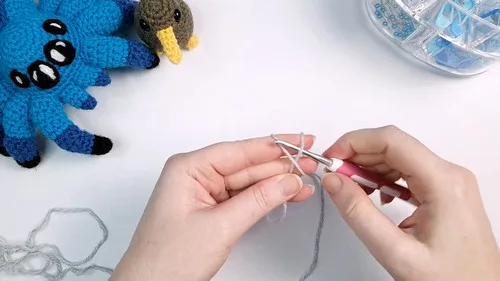
Round 1Start with six single crochet (sc) in a magic circle.
Round 2Do six increases (inc) by putting two sc in each stitch from the previous round.For Round 3: One sc, then an inc. Repeat this six times. (End with 18 stitches.)
Round 4Eighteen sc around.
Round 5Five sc then an inc, repeated three times. For Round 6: Twenty-one sc around.
Round 7Working in front loops only Six sc followed by an inc, repeat three times.
Round 8Three sc then an inc, repeat six times. (Back to working in both loops)
Finishing Off
Cut a short tail, use a needle to weave in the end, and close up the hole.
Creating and Attaching the Beak: In the second color, start with four sc in a magic circle.
Round 2One increase, followed by three sc.
Rounds 3–5Five sc each round (Alternatively, 15 sc consecutively). Leave a tail long enough for sewing and attach the beak between the safety eyes.
Continuing with the Body
Round 9to 12: Thirty sc each round.
Round 13Three sc followed by an invisible decrease; repeat six times around.
Round 14Start with nine sc. Swap to your second color without completing the stitch, finish the stitch with the new color.Create the popcorn stitch by doing five double crochet (dc) all in the same stitch, then completing the stitch with a slip stitch into the first dc, and chain one.Switch back to the main body color towards the end to complete the round with eight sc.For Round 15:Two sc, then a decrease repeated six times. Include working into the chain one of the popcorn stitches.
Round 16Alternate one sc and one decrease around.
Round 17 (Final Round): Six decreases.
Putting it together
Step 1
Creating and Attaching the Beak:: In the second color, start with four sc in a magic circle.
Step 2
Round 2:: One increase, followed by three sc.
Step 3
Rounds 3-5:: Five sc each round (Alternatively, 15 sc consecutively).
Step 4
Leave a tail long enough for sewing and attach the beak between the safety eyes.
Marlene's notes
💡Note 01
Work with a 3.5 millimeter hook and keep your tension on the snug side throughout — amigurumi stitches that are too loose will let stuffing show through, especially around the smaller early rounds of the head.
💡Note 02
The color change on Round 14 happens mid-stitch, not at the start of the round, so swap colors before completing the last pull-through of the ninth stitch rather than after it.
💡Note 03
Stuff as you go rather than leaving it all for the end — once you're past the increases into the straight rounds of the body, it's much easier to pack stuffing firmly before the opening narrows.
Porch photos
Before you sit down
Check you've got enough 8-ply yarn in both colors on hand — the body uses far more than the beak, so wind off or weigh your main color before you commit the rest to anything else.
Have your stitch markers ready from round one; with rounds running from six stitches up to thirty, you'll want to mark the start of each round rather than guess your way around.
Read through Round 14 before you get there — the color swap mid-stitch and the popcorn stitch instructions are easier to follow once you've seen the whole sequence in advance.
Confirm your safety eyes fit your gauge; the pattern calls for nine millimeter eyes but notes that 12 mm were used with thicker yarn, so decide which suits your yarn before the head is stuffed shut.
How the hours go
Head and Body (Worked as One Piece)
about 45-60 minutes because the six rounds move through increases quickly and set the shape for everything after
Continuing with the Body
about 90-120 minutes because the straight rounds of thirty stitches take longer to work around and the popcorn stitch color change needs a careful hand
Finishing Off (including the beak)
about 45-60 minutes because the beak is worked separately in four small rounds and then needs sewing precisely between the safety eyes
Looking after it
Hand wash your finished kiwi bird in cool water if it needs cleaning — 8-ply yarn generally holds up fine to a gentle wash, but skip the machine to protect the shaping and the safety eyes.
Reshape it gently while damp and let it air dry fully before handling, then store it stuffed and upright rather than squashed in a box so the popcorn stitch detail and the rounded body keep their shape.
Can I use a different hook size than 3.5 millimeters?
You can, but going up or down will change the size of your finished bird and may leave gaps for stuffing to peek through if you size up too much. If you do change hooks, work a small swatch first to check your stitches stay tight enough to hide the fiberfill.
Do I need exactly 12 mm safety eyes?
No — the pattern calls for nine millimeter eyes, and the 12 mm pair was only used because the yarn worked up thicker than expected. Choose whichever size looks proportionate once you've got a few rounds of the head worked up.
How much yarn do I need in the second color?
The second color is used for the beak, which is only a few small rounds, plus the popcorn stitch detail and color swap in Round 14, so you'll need far less of it than the main body color. A small amount set aside before you start should be plenty.
What's the best way to attach the beak?
Leave a long enough tail when you finish the beak's rounds so you have plenty to sew with, then position it between the safety eyes before stitching it down. Pin it in place first if you want to check the placement before committing.
Can I skip the popcorn stitch if I haven't done one before?
You could substitute a simple single crochet in its place, though you'd lose the raised texture the pattern is going for at that point in the body. It's worth practicing the popcorn stitch on a scrap first since it's only used in that one spot.
🧵
Sunday evening, from the glider —
The porch letter
A pattern and a note from the glider, most weeks.
🧵
Every round ticked off.
That was the last round. Would you like the letter when the next one goes up?