Intermediate 4-6 Hours Worsted yarn

Worked on the glider, counted out loud —

Crochet HDC Dog Sweater Pattern for Pet Lovers

Crochet a cozy HDC dog sweater with a ribbed collar, leg holes, and a built-in leash loop. A fun, worked-flat pattern for pet-loving crocheters.

Jump to the rounds

Before you sit down

Work the main body flat in half double crochet rows until you reach the end of Row 48.

Turn and pick up single crochets evenly along the side edge of those 48 rows to start the border.

Chain 8 and skip several rows along that edge to form the built-in leash loop opening.

Continue single crocheting along the remaining rows of the side edge to finish that border neatly.

Keep working the main body section, shaping the chest and belly area with a few decrease rounds.

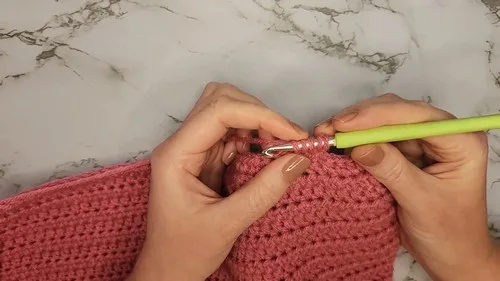
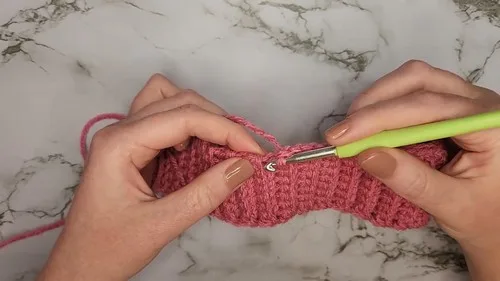
Finish the neckline with a ribbed collar worked in back-loop-only single crochet for a stretchy fit.

Assemble the pieces following the four assembly steps to complete the wearable dog sweater.

What this one is

This Crochet HDC Dog Sweater is a practical, pup-approved project built almost entirely in half double crochet, giving it a dense, warm fabric that holds its shape beautifully on a wiggly dog. What sets it apart is the clever construction: a side-edge single crochet border doubles as a built-in leash loop, so your dog can be walked in style without fumbling for a separate harness attachment. It's perfect for crocheters who love making things for their furry family members, or anyone hunting for a thoughtful handmade gift for a dog-owning friend.

The pattern leans on a handful of key techniques — working HDC rows flat, picking up stitches evenly along a side edge, chaining and skipping stitches to form the leg holes and leash loop, and a neat back-loop-only single crochet ribbing for the collar. It's a great next step after basic scarves or blankets, since you'll practice edge finishing and simple shaping without tackling complex increases or colorwork. Expect roughly four to six relaxed hours of stitching, depending on your dog's size and how chatty group is.

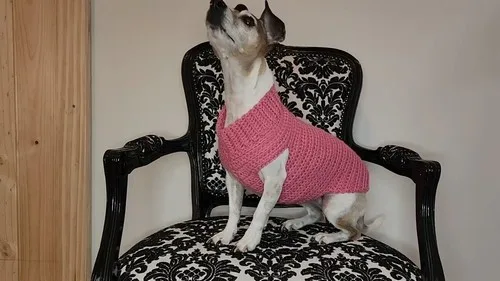
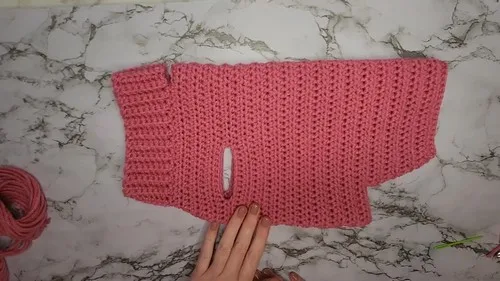
The finished sweater is a snug, ribbed-collar layer with clearly defined front leg openings and a sturdy chain-eight leash loop tucked into the side seam, all worked in a soft worsted-weight yarn that feels cozy against fur. It has that homemade-with-love look — texture-rich HDC fabric, a tidy rib at the neck, and a practical detail dog owners will actually use every day. Wrap it up with a little tag and it becomes a genuinely memorable gift for a new puppy, a rescue dog, or the dog who already has everything except a hand-stitched sweater.

Variations

This pattern is so easy to make your own! For a classic look, try navy or forest green worsted yarn like Vanna's Choice or With Love, then swap in a contrasting color just for the ribbed collar rounds to make the neckline pop. For a girl-dog version, work the main body in a soft blush or lavender and add a coordinating chain-8 loop in a metallic or sparkly yarn for extra flair on walks. If you're making this for a smaller breed like a Chihuahua or Yorkie, drop down to a 4 mm hook and work fewer HDC per row (aim for roughly 10-12% fewer stitches across Row 48 and the leg-hole rows) to shrink the overall width proportionally, checking fit against your dog's chest measurement as you go. For larger dogs, size up to a 6 mm hook with a bulkier yarn, which will also speed up your stitch count. Want a sportier feel? Alternate two colors every few rows through the Main Body Continued section for bold stripes, carrying the unused yarn loosely up the side edge so it's ready for the next stripe. You can also personalize the leash loop by working it in a super-sturdy cotton yarn like Lily Sugar'n Cream instead of matching the body yarn, since cotton resists stretching under leash tension better than acrylic. For texture lovers, try swapping the Chest/Belly Decrease rounds to a front-loop-only HDC for a subtle ribbed belly panel. And if you're feeling festive without going full holiday-theme, a simple color-blocked collar in a bright accent shade instantly makes this sweater feel custom-made rather than store-bought.

I designed this sweater because I was tired of dog sweaters that look cute but fall apart at the seams — or worse, have zero thought put into how you'll actually clip a leash on. The side-edge single crochet border that turns into a chain-8 leash loop is honestly my favorite detail in this whole pattern; it's such a simple trick, but it makes the sweater feel genuinely functional instead of just decorative. Working the main body in half double crochet gives you this dense, structured fabric that drapes just right on a dog's back without being floppy or see-through. I also love how the leg holes are formed right in the row — six HDC, chain 10, skip and continue — no separate seaming or guesswork about placement. And that back-loop-only ribbed collar? It gives the neckline a stretchy, knit-like finish that slides over a dog's head so much more comfortably than a plain HDC edge. This is the kind of pattern that comes together fast enough to finish in a weekend, but still teaches you real techniques you'll reach for again and again.
Common mistakes

  • Picking up the 20 side-edge singlePlace a stitch marker every 5 rows along the edge before you start, then space your 20 SC evenly between markers so the border lies flat instead of rippling.
  • Miscounting the skip-8-rows sectionCount and mark rows 1 and 8 with locking stitch markers before working the Chain 8, then double-check you've skipped exactly 8 rows before resuming single crochet.
  • Working the leg-hole chains (Chain 10)Chain slightly firmer than your usual tension for these bridging chains, or drop to a hook one size smaller just for that chain-10 section to keep the opening structured.
  • Forgetting to work the ribbed collar inBefore each collar round, consciously check that your hook is going under only the back loop of every stitch — it helps to turn the work slightly so you can see the loop clearly.
  • Losing track of stitch count throughCount your HDC stitches at the end of every decrease round and jot the number down; if it doesn't match your expected decrease pattern, unravel back to the last correct round rather than pushing forward.
  • Turning with the wrong chain heightRemember to Chain 1 before turning to work the side-edge SC (not the usual Chain 2 for HDC rows), since single crochet needs a shorter turning chain than half double crochet.

The rounds, in full

Written out, round by round

Intermediate4-6 Hours5 mmWorsted

Materials

Everything this one takes, in the order you will reach for it.

Yarn

  • 110g of Worsted or Medium-sized weight yarn (also called 10-ply)

Hook

  • 5 mm crochet hook

Gauge

  • A 10x10 cm square should be 12 rows of 14 half double crochet (HDC)

keep this to hand

Abbreviations

US crochet terms, as used in this pattern.

  1. scsingle crochet
  2. hdchalf double crochet
  3. bloback loops only
  4. hdc2toghalf double crochet 2 stitches together (decrease)

Ribbed Collar (Single Crochet Back Loop Only)

Start: Create a slip stitch and Chain 9 .

  1. Row 1Single Crochet (SC) in the second chain from the hook and in each chain across. You should have 8 SC .
  2. Rows 2-48Chain 1 and turn. Single crochet in the back loop only (BLO) across the row.You should maintain 8 SC .Repeat this for a total of 48 rows.

Neck Opening & Leash Loop

At the end of Row 48, Chain 1 and turn the work to crochet along the side edge of the 48 rows.

  1. Row 1Side Edge SC: Work 20 single crochets evenly into the first 20 rows along the side edge. Leash Loop Chain: Chain 8 . Leash Loop Skip: Skip 8 rows of the side edge SC. Remaining SC: Single crochet into the next row and continue for 19 more stitches until the end.End of Row 1: Chain 2 and turn.

Sweater Body (Chest Increase & Leg Holes)

This section is worked in Half Double Crochet (HDC).

Leg Holes (Row 8): This row creates the openings for the dog's front legs:

  1. Row 8First Side: Work 6 HDC . Leg Hole Chain: Chain 10 . Leg Hole Skip: Skip 10 stitches . Middle: Work 26 HDC . Second Leg Hole Chain: Chain 10 . Second Leg Hole Skip: Skip 10 stitches . Last Side: Work 6 HDC to the end.End of Row 8: Chain 2 and turn. (Total stitches remain 58)

Main Body Continued

  1. Rows 9-25HDC in every stitch across. (58 HDC) . Chain 2 and turn at the end of each row.
  2. Row 26(Tie Off): HDC in every stitch across. At the end, Chain 1 , cut the yarn, and pull through to fasten off.

Chest/Belly Decrease

Turn the sweater over. This section is worked in rows and decreases the width for the belly.

  1. Row 27(Start Belly): Skip 7 stitches from the edge. Attach yarn (slip stitch/Chain 2). Work 44 HDC across, leaving the last 7 stitches unworked.Chain 2 and turn.
  2. Row 28(Decrease): HDC2Tog over the first two stitches. Work 42 HDC . HDC2Tog over the last two stitches.Chain 2 and turn. (44 stitches)
  3. Row 29(No Decrease): Work 42 HDC across. Chain 2 and turn.
  4. Rows 30-35(Continue Decrease): Continue to alternate a decrease row (HDC2Tog at start/end) with a normal HDC row, following the pattern's stitch count, until you reach Row 35 .
  5. Row 35(Final Tie Off): Row 35 should have 36 HDC . At the end, Chain 1 , cut the yarn, and pull through to fasten off.

Assembly

Step 1

Seam: Fold the sweater in half and single crochet (or slip stitch) along the open side edge to join the front and back pieces.

Step 2

Finish Seam: Chain 1, cut the yarn, and fasten off.

Step 3

Weave in Ends: Use a yarn needle to weave in all loose ends.

Step 4

Turn Out: Turn the sweater the right side out for the finished look.

Important notes

Note 01

💡 Swatch first with your 5 mm hook to confirm you're getting 14 HDC and 12 rows per 10x10 cm square — dog sweaters need accurate sizing more than most projects since fit really matters.

Note 02

💡 Use locking stitch markers to flag the start and end of the skip-8-rows section for the leash loop so you don't accidentally skip too many or too few rows while counting.

Note 03

💡 Keep your 110g of worsted yarn wound into a center-pull ball or cake before starting — this project involves working across edges and chains where a tangle-free feed makes a real difference.

Note 04

💡 When picking up the 20 side-edge single crochets, insert your hook under both loops of each row-end stitch for a sturdy, non-gappy border that will hold up to leash tension.

Note 05

💡 Try the sweater's leg-hole placement against your actual dog (or a stuffed-animal stand-in of similar size) before finishing the Chest/Belly Decrease rounds, so you can adjust chain-10 spacing if needed.

Note 06

💡 Block the finished ribbed collar gently with a light steam pass to help the back-loop-only ribbing relax into its stretchy texture without flattening the stitch definition.

More photos

FAQs

Asked on the glider

the ones that come up on the glider

What size dog does this HDC sweater fit?

The pattern is worked to a 10x10 cm gauge of 14 HDC by 12 rows, so you can scale the stitch and row counts up or down to match your dog's chest and back measurements. It's best to measure your dog before starting and compare against your swatch to fine-tune sizing.

Do I really need the leash loop, or can I skip that part?

You can skip the Chain 8 leash loop section if you plan to always use a separate harness, but it's a genuinely handy built-in feature for quick walks. If you skip it, just continue the Side Edge SC straight through for all 20 stitches without the skip.

Why is the collar worked in back loops only instead of both loops?

Working in the back loop only creates a stretchy, ribbed texture similar to knit ribbing, which helps the collar slide over your dog's head and sit snugly without gapping. It's a small technique that makes a big difference in how professional the finished neckline looks.

What yarn works best for a dog sweater that gets washed often?

A durable worsted-weight acrylic or acrylic-cotton blend holds up well to frequent washing and resists pilling better than pure wool. Stick with machine-washable yarn since dog sweaters need regular cleaning.

Can I add sleeves or leave the leg holes larger for bigger dogs?

This pattern is designed with simple leg openings rather than full sleeves, formed by the Chain 10 and skip sections in Row 8 of the HDC section. For larger dogs, you can lengthen the chain slightly to widen the opening, just keep the adjustment symmetrical on both leg holes.