Intermediate 4-6 hours Worsted yarn

Worked on the glider, counted out loud —

Coral reef fish crochet beach tote pattern

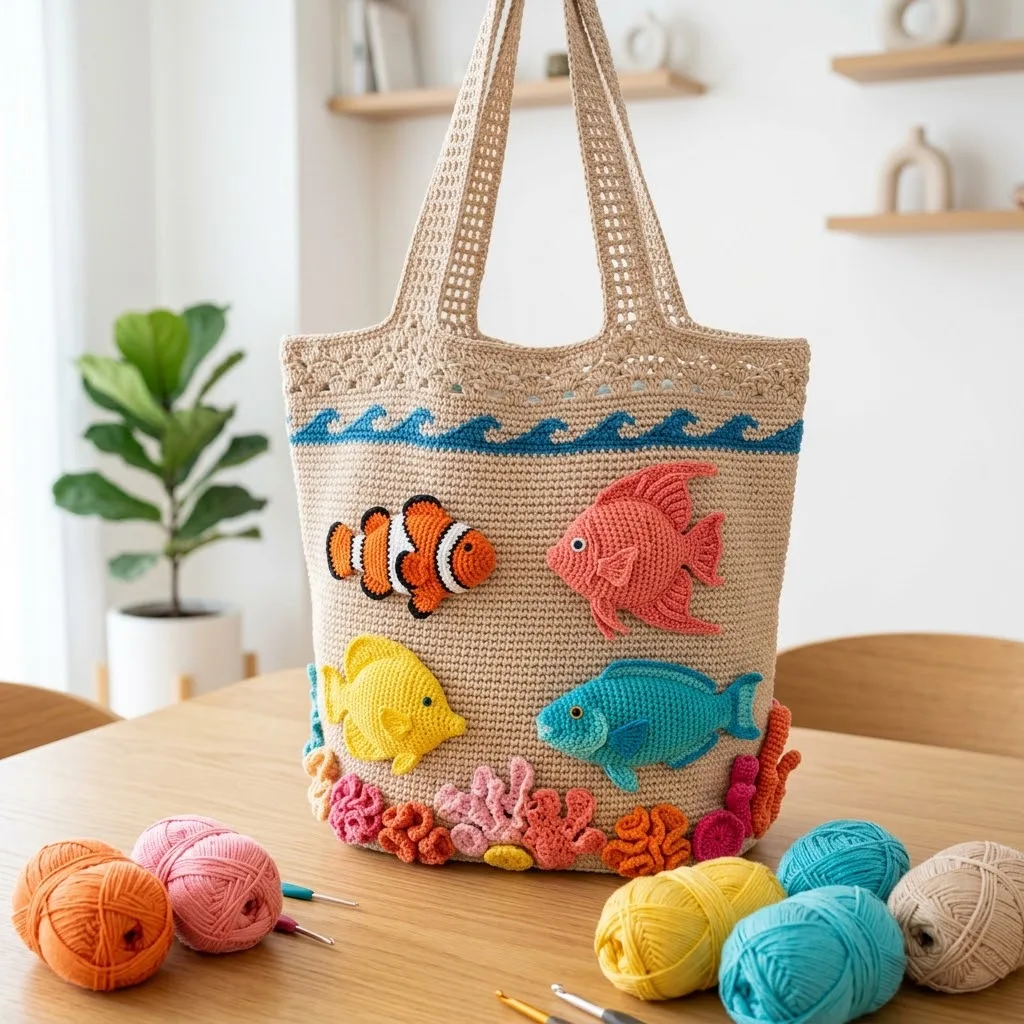
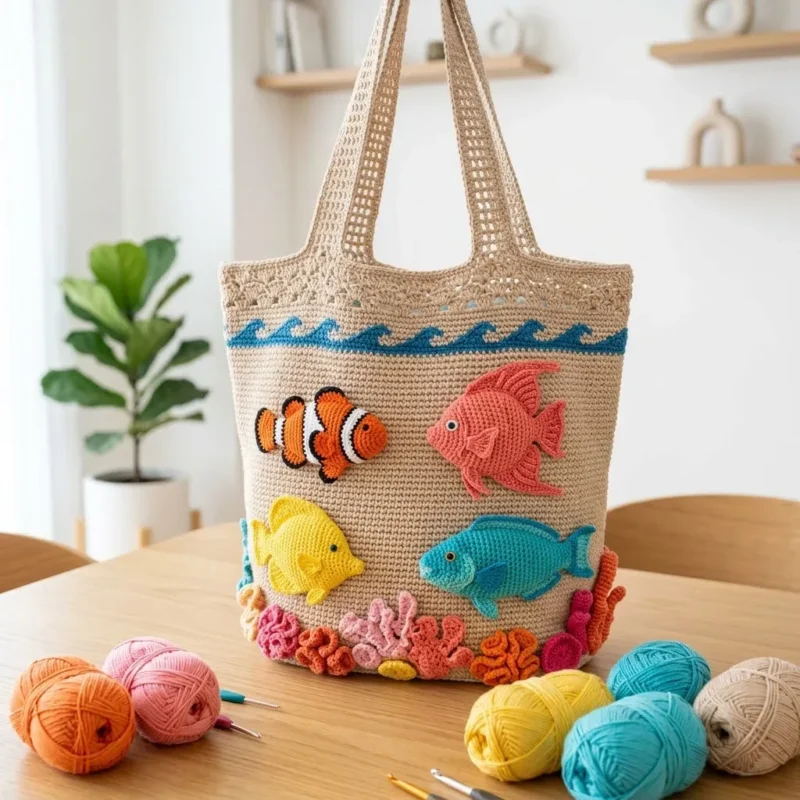
A roomy cotton tote with crochet fish and coral appliqués, a multi-session project for confident beginners.

Jump to the rounds

What this one is

I started swapping ideas for this tote around on a warm evening, thinking about the person who'd actually carry it: someone who loves the ocean even on the days they can't get to it, who wants something sturdy enough for the farmers market and charming enough to make strangers ask where you got it. This one is for anyone who likes bold color against plain tan, and who doesn't mind a project with a few small pieces to keep a lap busy.

Your hands spend most of their time on two long single crochet panels, worked back and forth until each reaches sixty rows tall, then shift to smaller, fiddlier work: a pair of handles built row after row, and a handful of fish and coral shapes made in rounds with two different hook sizes. Expect this to stretch over several sittings rather than one go, with the panels taking the bulk of the time and the appliqués filling in shorter stretches afterward.

Try it another way

If you want a smaller bag, shorten the body panels - they're worked in plain single crochet at 56 stitches wide, so you can stop before row 60 and still have a usable tote, just a little shorter than the 15-inch finished height. The handles are just as easy to adjust: worked at 8 stitches wide, you can add or subtract rows from the suggested 100 to sit the strap higher or lower on your shoulder. For color, the pattern already leans on tan/sand, blue, coral, and turquoise, but you could swap the assorted pinks, oranges, and greens in the coral for a single family of color if you want a calmer reef, or push the contrast harder if you want the appliqués to really pop against the sand-colored panels. The scalloped wave row across 112 stitches reads nicely in a second shade of blue instead of matching the main color, which gives the top edge its own line without extra yardage. If you'd rather skip the appliqué work altogether, the plain panels and wave trim make a perfectly good beach tote on their own, and you can always add fish and coral later once you've lived with the bag for a while.
The rounds, in full

Written out, round by round

Intermediate4-6 hours5.0 mmWorsted

Bring to the porch

Everything this one takes, in the order you will reach for it.

Yarn

  • Worsted weight cotton yarn (I recommend 100% cotton for durability and easy washing)
  • Main color (tan/sand): approximately 400 yards
  • Blue (for waves): approximately 40 yards

Orange

  • approximately 30 yards
  • Coral/salmon pink: approximately 30 yards

Yellow

  • approximately 25 yards
  • Turquoise/aqua: approximately 30 yards

White

  • approximately 15 yards

Black

  • small amount for eyes
  • Assorted pinks, oranges, and greens for coral: approximately 50 yards total

Hook

  • 5.0mm (H/8) crochet hook for bag body
  • 4.0mm (G/6) crochet hook for appliqués (optional, for tighter stitches on small pieces)

Notions

  • Tapestry needle
  • Stitch markers
  • Scissors
  • Pins for appliqué placement
  • Gauge
  • 16 stitches and 18 rows = 4 inches in single crochet with 5.0mm hook and worsted weight cotton.
  • Finished Dimensions

Bag body

  • approximately 14 inches wide x 15 inches tall (not including handles)

Handles

  • approximately 22 inches long each
  • Total height with handles: approximately 28 inches

Foundation

  1. Round 1Sc in 2nd ch from hook and in each ch across, turn. (56 sc)through 8: Ch 1, sc in each st across, turn. (56 sc) Fasten off, leaving a long tail for seaming.
  2. Round 2through 60: Ch 1, sc in each st across, turn. (56 sc) At the end of Row 60, fasten off and weave in ends.Repeat for the second panel.

A note for beginners:

If you lose count of your stitches, just count them at the end of each row for the first few rows until you get into a rhythm. You should always have 56 stitches.

Foundation

  1. Round 1Sc in 2nd ch from hook and in each ch across, turn. (8 sc)
  2. Round 2through 100: Ch 1, sc in each st across, turn. (8 sc) Fasten off, leaving long tails for attaching to bag.The handles may feel long, but they need to comfortably sit on your shoulder. Feel free to adjust the length by adding or subtracting rows.

Foundation

  1. Round 1Sc in 2nd ch from hook and in each ch across, turn. (112 sc)
  2. Round 2Ch 1, sc in first 4 sts, *hdc in next st, dc in next 2 sts, hdc in next st, sc in next 4 sts*, repeat from * across, turn. (112 sts)
  3. Round 3Ch 1, sc in each st across. (112 sts) Fasten off, leaving a long tail for sewing.

Body

  1. Round 16 sc into ring, pull tight, do not join. Place marker to track rounds. (6 sc)
  2. Round 2Inc in each st around. (12 sc)
  3. Round 3*Sc in next st, inc in next st*, repeat around. (18 sc)
  4. Round 4*Sc in next 2 sts, inc in next st*, repeat around. (24 sc)
  5. Round 5through 8: Sc in each st around. (24 sc)
  6. Round 9*Sc in next 2 sts, dec*, repeat around. (18 sc)
  7. Round 10*Sc in next st, dec*, repeat around. (12 sc) Stuff lightly if desired for dimension, or leave flat.
  8. Round 11Dec around. (6 sc) Fasten off and close hole. White Stripes (Make 3): Ch 8, sc in 2nd ch from hook and across. (7 sc) Fasten off. Sew vertically across body.

Body

  1. Round 16 sc into ring. (6 sc)
  2. Round 2Inc in each st around. (12 sc)
  3. Round 3*Sc, inc*, repeat around. (18 sc)
  4. Round 4*Sc in 2 sts, inc*, repeat around. (24 sc)
  5. Round 5through 9: Sc in each st around. (24 sc)
  6. Round 10*Sc in 2 sts, dec*, repeat around. (18 sc)
  7. Round 11*Sc, dec*, repeat around. (12 sc)
  8. Round 12Dec around. (6 sc) Fasten off and close.

Hook

5.0mm (H/8) crochet hook for bag body 4.0mm (G/6) crochet hook for appliqués (optional, for tighter stitches on small pieces)

Notions

Tapestry needle Stitch markers Scissors Pins for appliqué placement

Body

Follow the same body pattern as the coral pink fish through Round 12.

Body

Follow the same body pattern as the coral pink fish through Round 12.

This fish has a slightly rounder body, so you can add an extra round of 24 sc before decreasing if you want more size variation.

Marlene's notes

Note 01

Tension matters more than usual here, since two panels worked separately need to match up at 56 stitches wide when you seam them together.

Note 02

the assorted pinks, oranges, and greens in the coral, weave in color changes as you go rather than leaving long floats, since these pieces are small and floats will show.

Porch photos

Before you sit down

  • Lay out your yarn before you start: about 400 yards of tan/sand for the panels, plus the smaller amounts of blue, coral, turquoise, and assorted coral colors so you can see how the palette sits together.
  • Swatch first - 16 stitches and 18 rows should measure 4 inches in single crochet with the 5.0mm hook, so you know your tension matches before committing to 56-stitch-wide panels.
  • Read through Row 2 of the wave trim before you start it, since the hdc-dc-dc-hdc repeat across 112 stitches goes faster once you've seen the pattern once.
  • Set aside stitch markers for the appliqué rounds, since the small fish and coral pieces are easy to lose count on without one.

How the hours go

Two body panels
about 2-3 hours because each panel runs 60 rows at 56 stitches wide
Fish and coral appliqués
about 1-2 hours because each piece works up in 8 rounds, but there are several of them and the color changes slow things down
Handles and wave trim
about 1 hour because the handles are only 8 stitches wide across 100 rows, and the wave row's hdc-dc repeat across 112 stitches takes a little concentration

Looking after it

  • Since this is worked in cotton, you can machine wash it on a gentle cold cycle or hand wash it, and either way it will come out heavier than it went in, so support the weight when you lift it out of the water.
  • Lay the tote flat to dry and ease the panels and appliqués back into shape while they're still damp, then store it flat or lightly stuffed with tissue so the shape holds between uses.
FAQs

Asked on the glider

the ones that come up on the glider

Can I use a different yarn weight than worsted cotton?

You can, but the gauge of 16 stitches and 18 rows to 4 inches is based on worsted cotton with a 5.0mm hook, so a different weight will change your finished size. Cotton also holds its shape and washes well, which matters for a bag that's going to get used.

Why does the pattern use two different hook sizes?

The 5.0mm hook keeps the body panels structured enough to hold their shape as a bag, while the smaller 4.0mm hook tightens up the stitches on the small fish and coral appliqués so they look neat rather than loose.

How do I keep the two body panels the same size?

Count your rows as you go and check your stitch count stays at 56 across; working both panels from the same ball of main color and checking your gauge swatch first will help them match when you seam them.

Do I need to finish all the coral appliqués before assembling the bag?

It helps to make the fish and coral pieces first and pin them onto the panel before you seam the bag together, since that's the easiest way to see your reef layout and move pieces around before they're sewn down.

Can I make the handles shorter or longer?

The handles are worked at 8 stitches wide, and the row count is easy to adjust up or down from the pattern's length so the strap sits comfortably on your shoulder.

How long does this project take from start to finish?

Between the two body panels, the handles, and the fish and coral appliqués, plan on several sittings rather than one. The panels alone take the most time since they run many rows at 56 stitches wide.