Intermediate 4-6 hours Bulky yarn

Worked on the glider, counted out loud —

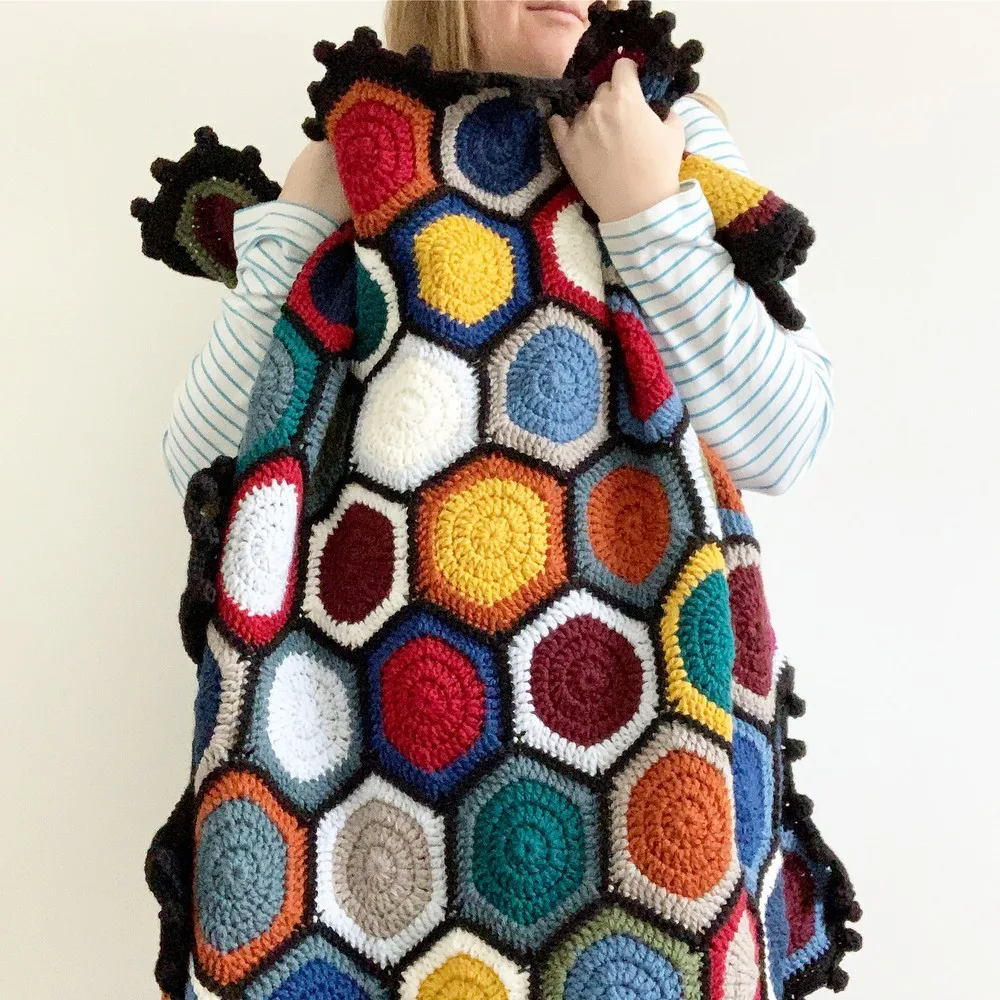
Colorful hexagon blanket for long winter evenings

A warm hexagon-motif blanket for confident beginners with some granny-square experience, worked over several cozy evenings.

Jump to the rounds

What this one is

You know the kind of evening this is for: the one where the light goes early and you want something in your lap that holds color like a stained-glass window. This hexagon blanket is built for whoever loves a project with a graph to follow and a palette that runs from Currant to Clarity. It suits a crocheter who has made a granny square before and is ready to let the colors do the talking.

Your hands spend most of this piece doing two things: building dc rounds into a tidy hexagon, then zig-zagging those hexagons together with slip stitches once the layout is set. Each motif is only four rounds, so the real rhythm comes from repeating it across however many hexagons your graph calls for, then adding the three-round border. Expect this to be a multi-session project — a few hours per sitting adds up fast with fifteen colors in rotation.

Try it another way

The easiest way to change the mood of this blanket is to shift the color graph: lean heavily on Currant, Cranberry, and Masala for a warm, saturated version, or build most hexagons in White, Gosling, and Ciel with just a few hits of Spruce or Navy for a cooler, quieter palette. Since round 4 is where the new joining color gets introduced, you can also use that round alone as an accent — keep rounds 1 through 3 in neutral shades like Coal or Winter Night and let round 4 carry all fifteen colors across different hexagons. For size, simply make more or fewer hexagons before you start the zig-zag join; the join-from-the-corner method scales to any number of motifs without changing the stitch pattern itself. If you want a lighter throw rather than a full blanket, stop after fewer hexagons and work only Border Round 1 and 2, skipping the dc5tog bobble round for a flatter edge. You can also swap which yarns go where in the materials list — using the same fifteen colors but reassigning them motif by motif gives you a genuinely different-looking blanket from the same instructions.

There's real satisfaction in watching a hexagon snap into its six-sided shape on round 4, when the plain circle you built in rounds 1 through 3 suddenly grows ch-2 corners and starts looking like something out of a stained-glass window. Working fifteen shades of Wool of the Andes Bulky means no two hexagons have to repeat, and laying them out on a color graph before joining turns the whole project into a design exercise, not just a stitch count. The join itself — a zig-zag slip stitch across the top right-hand corner outward — is satisfying in a different way: fast, almost meditative, and it locks every motif into place without a separate seaming session. By the time you reach the dc5tog bobble border, the blanket already looks finished; the bobbles are just the flourish.
The rounds, in full

Written out, round by round

Intermediate4-6 hours5.5 mmBulky

Bring to the porch

Everything this one takes, in the order you will reach for it.

  • US 5.5mm crochet hook
  • Needle for weaving in ends
  • Yarn (WeCrochet Wool of the Andes Bulky)
  • Colors: Currant, Cranberry, Masala, Honey, Fern, Spruce, Cadet, Clarity, Ciel, Winter Night, Navy, Fairy Tale, White, Gosling, Coal

Hexagon Motif

  1. Round 1Start with a chain of 4, sl st into the 4th chain to form a circle. Chain 2 (counts as a dc), then work 11 dc into the center of the circle. Sl st to the first DC to join.
  2. Round 2Chain 2, DC in the same sp. Work 2 dc in each st around, join with a sl st.
  3. Round 3Chain 2, dc in the same sp, then dc in next st, 2 dc in next st around. Join with a sl st.
  4. Round 4Hexagon Shape Join the new colour. Chain 2 in any st, in same st work 1 dc, ch 2, 2 dc. Then dc in next 5 sts, in next st work 2 dc, ch 2, 2 dc. Repeat around and join.

Border

  1. Round 1Join border color in a corner, ch 1, hdc in the next 9 sts, 3 hdc in the corner. Repeat around and join.
  2. Round 2Ch 1, follow the pattern outlined in round 1, adjusting the number of hdc as necessary to smooth the border.
  3. Round 3Bobbles Work a dc5tog followed by sl sts around the border for a decorative edge.

Putting it together

Step 1

Layout hexagons following the color graph.

Step 2

Start from the top right-hand corner and join hexagons across using the zig-zag slip stitch technique.

Step 3

Finish off by weaving in all ends.

Marlene's notes

Note 01

Use the US 5.5mm hook consistently through all three parts; bulky wool can vary slightly in grip between skeins, so check your round 1 hexagon against your swatch if your gauge feels loose or tight.

Note 02

Round 4 of the hexagon introduces a new color and the ch-2 corner shaping at once, so work that round slowly and keep a marker in the corner ch-sp until you're sure of the shape.

Note 03

Weave in ends as you finish each hexagon rather than saving them all for the end — with fifteen possible colors in play, tails add up fast and are easier to track one motif at a time.

Before you sit down

  • Lay out all fifteen colors of Wool of the Andes Bulky side by side and sketch or print your color graph before you make a single hexagon — the layout step depends on having that plan in hand.
  • Make one full hexagon motif first (all 4 rounds) as a swatch, mainly to confirm your dc tension matches the shape you expect once round 4 forms the corners.
  • Place a stitch marker in the first dc of each round while you're new to the motif, since round 1's join-to-first-dc is easy to miscount in a bulky yarn.
  • Read through Border Round 2 before you start joining hexagons, since it asks you to adjust hdc counts to smooth the edge — knowing that in advance saves ripping back later.

How the hours go

Hexagon Motif (per piece)
about 25-35 minutes each because it is only 4 rounds but round 4's corner shaping takes a careful eye
Layout and zig-zag joining
about 1-2 hours because matching the color graph and working the join from the top right corner outward takes patience across many hexagons
Border, all 3 rounds
about 1 hour because round 2's stitch-count smoothing and round 3's dc5tog bobbles both ask for attention to detail

Looking after it

  • Hand wash in cool water with a wool-safe detergent, since Wool of the Andes Bulky is a wool fiber that can felt if agitated or washed hot.
  • Lay the blanket flat on a towel to dry and gently reshape the hexagon edges and border corners while damp; store it folded in a breathable space rather than a sealed bag to let the wool breathe.
FAQs

Asked on the glider

the ones that come up on the glider

How many hexagons do I need for a full-size blanket?

That depends on the finished size you want, since the pattern works from a color graph you lay out yourself rather than a fixed hexagon count. Make a swatch hexagon first to measure its size, then calculate backward from your target blanket dimensions.

What's the trickiest part of this pattern?

Most crocheters find Round 4 of the hexagon motif the fiddly point, since it introduces a new color at the same time as the ch-2 corner shaping that turns the circle into a six-sided shape. Go slowly through that one round and the rest of the piece moves quickly.

Do I need to join a new color for every round?

No — only Round 4 of the hexagon motif and the border rounds call for a color join in the pattern as written. Rounds 1 through 3 of the hexagon can stay in the same color.

How do I join the hexagons together?

You lay all your finished hexagons out according to your color graph, then start from the top right-hand corner and work across using the zig-zag slip stitch technique. This method joins motifs without a separate seaming pass afterward.

What does the dc5tog bobble border actually do?

It's the final round of the border, worked as a dc5tog followed by slip stitches repeated around the edge, and it gives the blanket a textured, decorative finish rather than a flat edge. It's worked after Border Rounds 1 and 2 have already smoothed the perimeter with hdc.