Beginner 45 minutes - 1 hour DK yarn

Worked on the glider, counted out loud —

How to crochet a tulip bouquet coaster in rounds

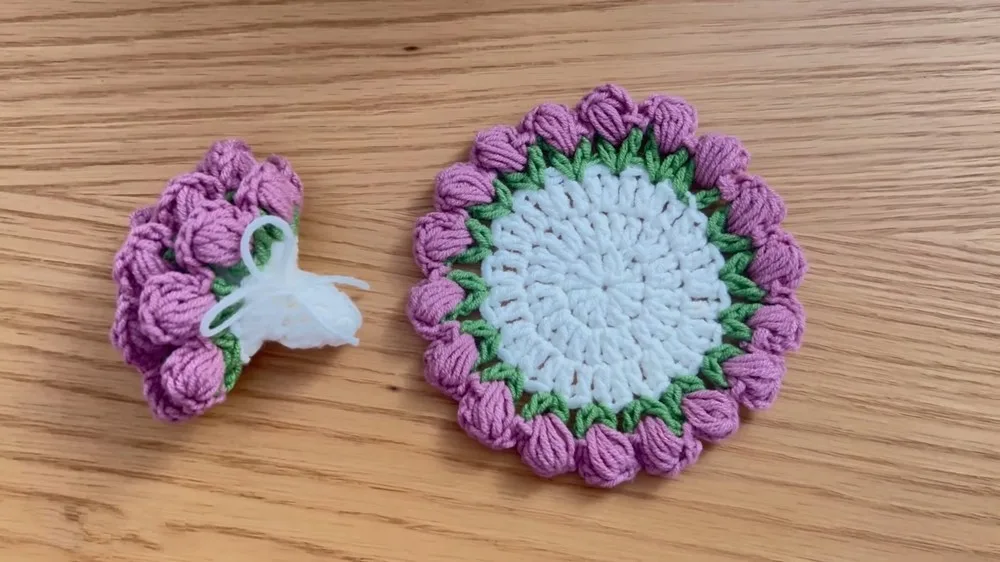
A quick three-round coaster with a tulip-look color change, great for using up scrap yarn, about an hour to make.

Jump to the rounds

What this one is

I made this tulip bouquet coaster on a quiet Sunday afternoon, the kind where you want your hands busy but your mind free to wander. It's for the crocheter who wants a finished thing before the tea gets cold, or the friend who never has a coaster that matches the mug she loves. Two colors, one small stack of stitches, and you have a little garden sitting under your cup.

Your hands stay in double crochet the whole way, working three rounds out from a magic ring, with a single color change partway through to bring in the tulip shade. There's no shaping to puzzle over, just a steady increase from twelve stitches to twenty-four, then a shell-like rhythm of two-in-one, one-in-one around the edge. Start to finish, you're looking at well under an hour, maybe two if you're making a matching set.

Try it another way

If you want a smaller coaster, stop after round two. You'll have a plain circle of twenty-four double crochets, no color change needed, which is handy if you're short on time or a second color. Go the other way and keep repeating the two-in-one, one-in-one shell pattern for a couple more rounds, and the same stitches expand into a small mat or trivet. Swap the color change so the outer round is your main shade and the center twelve stitches are the accent instead, same construction, different bloom. For yarn, cotton gives you a coaster that actually soaks up condensation, while a soft acrylic makes it more of a decorative mat. You can also skip the second color completely and work all rounds in one shade if you'd rather have a plain circle for texture alone. Made in multiples, these stack up fast into a set for a table, or you can join a few edge to edge with slip stitch for a longer table runner. Try a variegated yarn for the outer round instead of a plain color change, and the tulip shape reads more like a scattered garden.

There's something deeply satisfying about watching twelve stitches become twenty-four in a single round, all from one tidy magic ring you can pull snug with a tug. The color change is the real treat here: you slip stitch the new shade in cleanly at the start of a round, and suddenly your coaster has a second color radiating out from the center like petals opening. Then comes the shell rhythm, two double crochets in one stitch, one in the next, repeated around, which turns a plain circle into something with edges and personality. It's forgiving work with a 3mm hook, quick enough to finish in one sitting, and every round teaches you something you'll use again: ring starts, flat increases, clean color joins.
The rounds, in full

Written out, round by round

Beginner45 minutes - 1 hour3 mmDK

Bring to the porch

Everything this one takes, in the order you will reach for it.

  • Yarn (preferably the type mentioned in the video)
  • 3mm crochet hook

Start

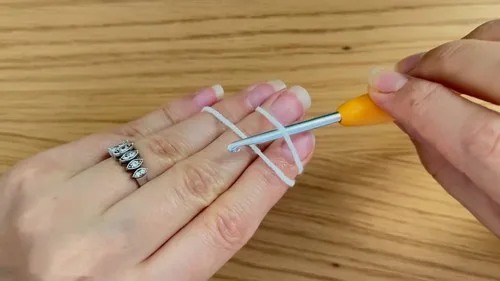
Magic Ring:

Start with a white color yarn. Make a magic ring by placing the yarn between your fingers and use the crochet hook as described to create the ring.

  1. Round 1Chain 3: These count as the first double crochet.

Double Crochets

Make 11 double crochets into the magic ring, for a total of 12 stitches when including the initial chain 3.

Slip Stitch: Close the round with a slip stitch into the third chain of the starting chain-3.

  1. Round 2Chain 3: Start the new round with a chain of 3.

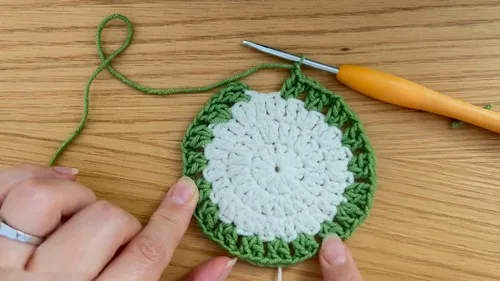
Color Change

Before completing the round, introduce a new color by attaching it with a slip stitch then proceed with 3 chains.

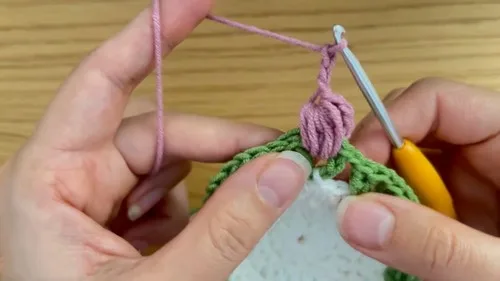
  1. Round 4Pattern Continuation: With the new color, follow the pattern described above, making chains and double crochets as instructed, including one double crochet, chain, and skipping stitches as outlined.

Double Crochets

  1. Round 1In the same space as the chain 3, and in each stitch around, make two double crochets (resulting in 2 double crochets into each space from the previous round). By the end, you should aim for 24 double crochets in total.(24)
  2. Round 2Slip Stitch: Join the round with a slip stitch to the third of the starting chain-3.
  3. Round 3After Round 3: Chain 3: As before, start the round with a chain-3.

Marlene's notes

Note 01

Hook: a 3mm hook keeps the stitches snug enough that the coaster holds its shape under a mug rather than curling at the edges.

Note 02

Color change: introduce the new shade with a slip stitch before the chain-3, so the join sits neatly inside the round rather than showing as a stray loop.

Note 03

Tension: keep your double crochets even in height, since a coaster lies flat only if every stitch in a round matches its neighbors.

Porch photos

Before you sit down

  • Check you have your main yarn and a contrasting color ready before you start, since the pattern calls for a color change partway through and it saves a mid-round scramble.
  • Have your 3mm hook out and test your gauge with the magic ring and first 12 stitches before committing to a whole stack of coasters.
  • Read through the color-change round once before you get there, since it happens at a specific point mid-round and it helps to know it's coming.
  • Set aside a stitch marker, or a scrap of yarn, to mark the third chain of your starting chain-3 so your join is easy to find at the end of each round.

How the hours go

Start and Round 1
about 10 minutes because it's just the magic ring and 12 stitches to close
Double Crochets, Round 2
about 10-15 minutes because you're doubling every stitch to reach 24 around
Color Change round
about 15-20 minutes because you're joining a new shade cleanly and keeping the two-in-one, one-in-one rhythm even

Looking after it

  • Since the materials list leaves the fiber up to you, hand wash in cool water if you've used a natural fiber like cotton, or run a gentle machine cycle in a bag if you went with acrylic, either way avoid wringing so the round stays flat.
  • Lay the coaster flat to dry on a towel, easing the color-change round back into shape with your fingers while it's damp, then store it flat or stacked with the others rather than folded, so the shell edge doesn't crease.
FAQs

Asked on the glider

the ones that come up on the glider

Can I make this coaster without changing color?

Yes, you can work all three rounds in one shade if you prefer a plain circle. The stitch counts stay exactly the same, you just skip the slip-stitch join for the new color.

What size will the finished coaster be?

The pattern doesn't specify a finished measurement, since that depends on your yarn weight and tension with the 3mm hook. Work a swatch through round two to see how big your twenty-four stitches sit before deciding if it needs adjusting.

Why did my coaster start to cup instead of lying flat?

This usually means your double crochets are too tight or an increase got missed somewhere in the round. Check that round two lands on twenty-four stitches before you move on.

How do I make the color change look neat?

Slip stitch the new color in right before you start the chain-3, then carry or weave in the old tail as you go so it doesn't peek through the shell stitches on the next round.

Can I use leftover scrap yarn for this?

Absolutely, this is a great scrap-buster project since it only needs a small amount of two colors and a 3mm hook.

How many coasters do I need for a set?

That's entirely up to your table, though four matching coasters made with the same color change placement is a nice, tidy set to start with.