Intermediate 2-3 hours 4-ply yarn

Worked on the glider, counted out loud —

Granny sun square and coaster in two colors

A two-color granny sun square you can work into a coaster or full square — about 2-3 hours, suited to intermediate crocheters.

Jump to the rounds

What this one is

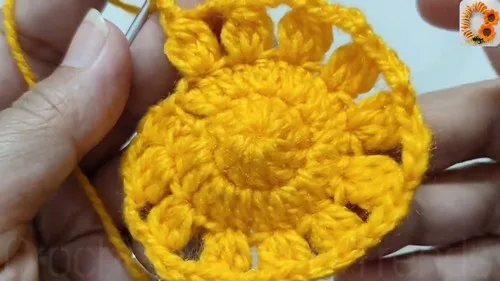
This one's for you if you've got a quiet hour and a hankering to see color do something clever. The granny sun square starts the same way a hundred grannies do — a magic ring, a ring of double crochets — but by round three it opens into a bright little starburst that makes the extra concentration worth it. Make one and it's a coaster. Make nine, and you've got the start of something bigger.

Try it another way

The easiest change you can make is deciding where to stop. Finish after round three and you've got a tidy coaster with its sunburst centered on the 12 double crochets from round one. Keep going through the additional and final rounds and that same center grows into a full granny square, corners built up round after round until it's ready to join with others into a blanket. Play with your two colors too — keep the same pairing for every piece so a set of coasters reads as a matched family, or vary the second color each time so the center ring is the only thing that repeats. Because this calls for four-ply acrylic and a 2.5 mm hook, you can also size up to a heavier yarn and a larger hook for a bolder, faster square, though your increases and spacing may shift slightly from round to round. If you're making several, work round three in each before moving any piece further — it keeps your color sequence consistent across the whole batch. A handful of squares in one palette, a scatter of coasters in another.

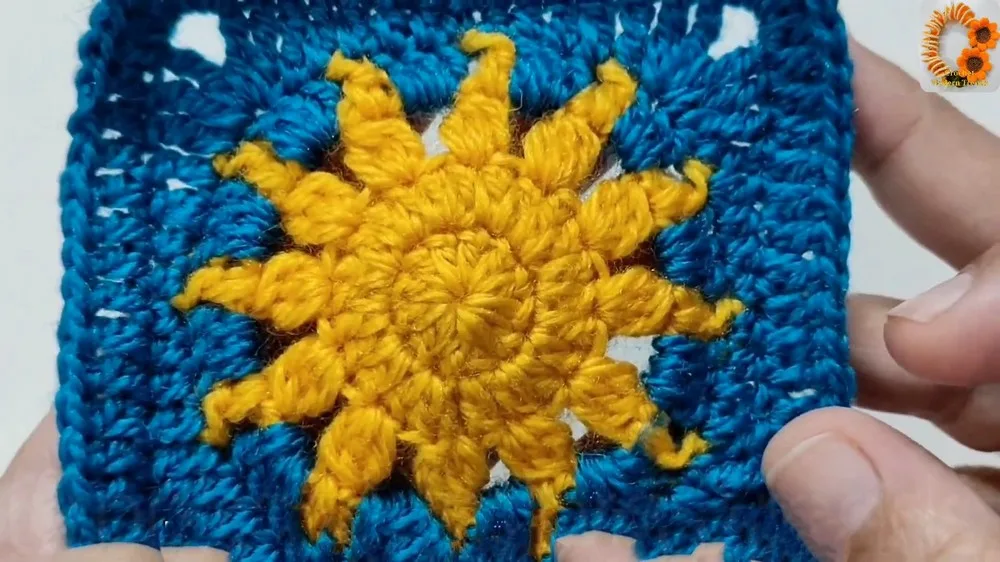
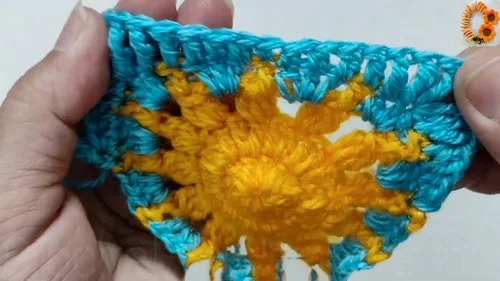
The pleasure in this piece lives in round three. You build a magic ring and two plain rounds of double crochet like always, then round three asks you to hold several double crochets open on the hook at once, pull through all the loops together, and swap colors mid-sequence — that's what turns a flat circle into a sunburst with real dimension. It's the kind of stitch that looks complicated from across the room and feels perfectly logical once your hands know the rhythm. After that drama, the later rounds settle back into familiar double crochet with corner increases, letting you finish calmly once the hard part's behind you. Two colors, one hook size, and a technique that teaches your fingers something new by round three.
The rounds, in full

Written out, round by round

Intermediate2-3 hours2.5 mm4-ply

Bring to the porch

Everything this one takes, in the order you will reach for it.

  • Acrylic four-ply yarns in two colors
  • Crochet hook (2.5 mm)

Main Pattern

  1. Round 1Start with a magic ring; Chain three (this counts as the first double crochet); Make 11 more double crochets into the ring (total of 12 double crochets); Pull the yarn to close the circle; Join with a slip stitch to the top of the chain three.
  2. Round 2Chain three on the top of the joining stitch; In the same stitch, make two more double crochets; In each stitch around, do two double crochets; Join with a slip stitch into the third chain of the beginning of the round.
  3. Round 3Chain two, then in the same stitch make two double crochets but do not close the last stitch of each (three loops on the hook); Yarn over and pull through all three loops, chain three for a chain space; Skip the next stitch, and in the following stitch, start a series where each double crochet is partially completed and held on the hook; Yarn over and pull through all loops on the hook, chain three for a chain space; Repeat around, and join with a slip stitch to the top of the beginning chain.Change of Colors: Attach a new color yarn by pulling through and begin the next sequence into the chain space; Perform a series of double crochets into each chain space, alternating yarn colors, but each time partially completing the stitches and switching colors before closing; Continue this pattern all around.

Additional Rounds: Continue with patterns of double crochets, single crochets, half double crochets, and treble crochets as described, stepping up each round with increases at the corners to maintain the square shape; Each new round starts with chaining which counts as the first stitch (either double or treble crochet based on the round's requirement); Sides of the square increase uniformly, creating spaces where new intricate loops and color changes can be done; Finish each round by joining with a slip stitch and continue with the next round by changing colors if required.

Final Rounds: The last few rounds are typically a repetition of one double crochet on top of each stitch around, with increases at the corners to maintain the square shape; Complete the rounds as described, join with a slip stitch, and cut the yarn to finish.

Marlene's notes

Note 01

Keep an eye on your tension through round three; those partially completed double crochets want to stay snug or the sunburst loses its crisp shape.

Note 02

A 2.5 mm hook with four-ply acrylic gives a firm little fabric, which is exactly what you want for something destined to hold a mug.

Note 03

Carry your yarn tails along the back of the work when you change colors rather than cutting and rejoining each time, to keep round three tidy on the wrong side.

Porch photos

Before you sit down

  • Wind both colors of your four-ply acrylic into easy-access balls before round three, since you'll be dropping and picking up yarn mid-stitch.
  • Place a stitch marker in the top of your starting chain three at the start of each round, so your join stays easy to find.
  • Work a small swatch with your 2.5 mm hook first, to check your double crochets aren't too loose for the sunburst to hold its shape.
  • Read all of round three through once before you pick up your hook — the partial stitches and color swaps go faster once you know what's coming.

How the hours go

Rounds 1 and 2 (the base)
about 10 minutes, because it's just 12 double crochets built up with two plain increase rounds
Round 3 (the sunburst)
about 20-30 minutes, because the partial stitches and color changes ask you to slow down
Additional and final rounds (squaring it off)
about 1-2 hours, because each round adds corner increases and color changes until the square is finished

Looking after it

  • Acrylic four-ply washes up easily — a gentle machine cycle in cool water is usually enough, and it won't felt or shrink the way wool might.
  • Lay the piece flat to dry and smooth the corners into shape by hand while it's still damp; once dry, it holds that shape well in a drawer or basket without needing to be blocked again.
FAQs

Asked on the glider

the ones that come up on the glider

Can I make this as a coaster instead of a full square?

Yes — stop after round three and you'll have a self-contained sunburst circle sized for a mug or glass, with no further rounds needed.

Do I need special yarn for this?

No, standard four-ply acrylic in two colors and a 2.5 mm hook is all the pattern calls for, which keeps the fabric firm enough for a coaster.

My corners don't look square enough — what went wrong?

Check that you're working two double crochets into each corner stitch on the plain rounds and starting each new round with the chain three that counts as your first stitch; missing either one will round off the corners.

How many rounds make a full square versus a coaster?

Three rounds give you the coaster-sized sunburst circle; continuing through the additional and final rounds builds it out into a full granny square with straight sides and increased corners.

Can I join several of these into a blanket?

Yes, once you've worked through the final rounds each square has straight sides and crisp corners, making them easy to whip-stitch or slip-stitch together in a block.